

Three things separate a good London kitchen company from a bad one, and none of them is the showroom. Whether the person who designs your kitchen stays with your project. Whether the price you are given is a fixed quotation or an estimate. And whether the company is still answerable to you after the last unit goes in. Everything else is detail.
Before you read further, you should know that Arch KBB is one of the companies you might be comparing. We design, supply and install kitchens from a showroom in Hammersmith. So rather than publish a list with ourselves at the top, this page sets out the questions we think you should ask anybody, and we would encourage you to ask us the same ones.
Why “best” is the wrong question
There is no best kitchen designer in London, because London kitchens are not one problem.
The company that does beautiful work in a wide, square room in a new development may struggle in a narrow Victorian side return where the answer depends on losing 200mm from a chimney breast. The studio that produces the most striking drawings may not be the one that turns up when a worktop arrives with a chipped edge. A firm’s published portfolio tells you what it can make. It does not tell you how it behaves when something goes wrong, which is the part you actually buy.
So the useful question is not “who is best?” It is “who is right for this room, this budget and this way of working?”, and that you can only answer by asking.
The four kinds of company you are comparing
Most London kitchen companies fall into one of four models. They are not better or worse than each other; they solve different problems, and confusing them is the most common reason people end up disappointed.
National retailers and showroom chains
Large ranges, familiar names, frequent promotional pricing, and processes built for volume. The design work is usually done in the showroom to a set template.
Suits: straightforward rooms, buyers who value price certainty and a recognisable brand. Watch for: design flexibility in an awkward room, who actually carries out the installation, and how much of the advertised discount is a genuine reduction.
Independent design studios
You pay a design fee for the drawings and specification, then buy and install the kitchen separately, sometimes through the studio’s suppliers, sometimes not.
Suits: complex or architecturally led projects, and buyers who want independent design advice with no product agenda. Watch for: the total cost once supply and installation are added, and who takes responsibility if the design does not work in practice.
Independent showrooms that design, supply and install
Design, products and installation come from one company under one contract. This is Arch’s model, and we should declare that plainly.
Suits: buyers who want one accountable point of contact and do not want to stand between a designer, a supplier and a fitter. Watch for: the range on offer is necessarily narrower than the whole market, and you are relying on one company across all three stages, so its financial stability and its after-sales behaviour matter more than they would elsewhere. Ask about both.
Fitters, builders and joiners
Installation-only, or bespoke joinery made to order. No showroom, often no design service.
Suits: buyers who have already chosen and bought a kitchen, or who want something genuinely made rather than assembled. Watch for: who is liable if a supplied unit is wrong or damaged, and who resolves it, because it will usually be you.
Ten questions to ask before you appoint anyone
Take these to every company you meet, including us. The answers matter less than how readily they come.
- Who will design my kitchen, and will that person still be involved at installation? Designers move on and projects get handed over. You want to know who owns your project at the end, not just at the start. Weak answer: “one of our team will look after you.”
- Is this a fixed quotation or an estimate? These are different things, and the difference can be thousands of pounds. See what a kitchen renovation costs in London for typical price ranges before you compare quotes. Weak answer: any figure given before somebody has measured the room.
- What is excluded? Ask specifically about making good, decorating, flooring, waste removal, appliance disconnection and reconnection, and worktop templating. Weak answer: “everything’s included” without a written list.
- Who installs it, and who employs them? If installation is subcontracted, ask who you contact when there is a problem. Weak answer: hesitation.
- What happens if a unit arrives damaged or wrong? Every kitchen has at least one. You are testing the process, not the promise. Weak answer: “that doesn’t happen.”
- What is the payment schedule, and what does each stage buy? Deposits are normal; large payments long before anything is delivered are not. Weak answer: a big up-front figure with no milestones.
- How long from order to installation, and what drives that? Lead times vary by range and appliance. Weak answer: a confident date with no reference to what has been ordered.
- Can I see a kitchen you finished three years ago? Anyone can show you last month’s work. Three years shows you how the doors, hinges and worktop have held up. Weak answer: only recent projects, or only photographs.
- How are the worktops fabricated, and by whom? Templating and fabrication are specialist work, and stone cutting has genuine safety requirements. See how worktop materials compare for more on this. A company that answers this easily is telling you something about the rest of its supply chain.
- Something fails eighteen months after handover. What happens? Ask who you call, what is covered, and by whom: the manufacturer, the installer or the company you paid. Weak answer: anything vague.
If a company will not put its answers to questions 2, 3 and 6 in writing, that tells you what you need to know.
What to look for on a showroom visit
A showroom is a sales environment, so use it as a testing environment instead.
Open things. Pull a drawer out fully. Feel whether it is soft-close or just heavy. Look at how the drawer box is built, not the front.
Look at the edges. The join between the worktop and the upstand, the fit of the end panels, the alignment of doors across a run. That is where build quality shows.
Ask what is on display and what is not. Showrooms display their best ranges. Ask what a kitchen at your budget actually looks like, and ask to see it.
Take samples to a window. Every finish changes in daylight. Every stone changes at full scale.
Notice whether anyone measures. A company genuinely interested in your project will want the room’s dimensions early. One that only wants your budget is selling, not designing.
What a proper design proposal contains
Before you pay a deposit anywhere, you should have received something you could hand to a third party and have them understand exactly what you are buying:
- a plan of the room with dimensions
- elevations showing every run, at height
- a specification schedule listing each unit, door, worktop, handle and appliance by name
- an itemised price, separating products from installation from any preparation work
- a written statement of what is excluded, and
- the payment schedule and lead-time expectation
A single-page total with a picture attached is not a proposal. If you cannot compare two companies line by line, you are not comparing them at all.
Warning signs
- A discount that expires today, or a price that drops sharply when you say you are still looking.
- A quotation produced before anybody measured the room.
- Pressure to pay a deposit at the first meeting.
- No written specification, or one that names no products.
- No trading address, or a company you cannot find at Companies House.
- Reluctance to give a reference from a completed project.
- An answer to “what is excluded?” that is shorter than one sentence.
None of these alone proves bad faith. Two or three together is a pattern.
Protecting your deposit
If you are paying a deposit, consider paying at least part of it by credit card. Under Section 75 of the Consumer Credit Act 1974, where the cash price of the goods or services is more than £100 and no more than £30,000, you can raise a claim against your card provider as well as the supplier if there is a breach of contract or misrepresentation. It applies even if only part of the payment was made on the card, and it is the cash price that matters rather than the amount you put on the card.
Source: Financial Ombudsman Service, “Problems with goods and services: section 75 and chargeback”, financial-ombudsman.org.uk, checked 24 August 2026. This is general information, not financial or legal advice. Check your own card terms.
Where Arch fits, and where we are the wrong choice
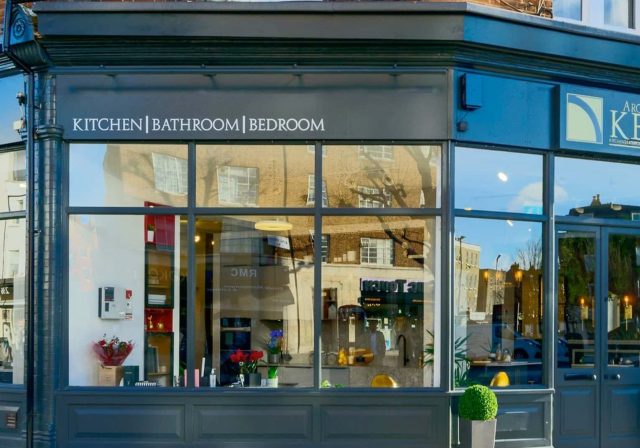
Arch KBB designs, supplies and installs kitchens from a showroom at 323-325 King Street, Hammersmith. We work mainly across West London. You can buy a kitchen from us and use your own fitter, or hand us the whole project and have one team run it.
We are honestly not the right choice if:
- you want labour-only fitting for a kitchen bought elsewhere, we install what we supply;
- your project needs an extension or a loft conversion, we do not do either, and that work has to be arranged separately;
- you want the widest possible product choice, in which case an independent design studio with no supply relationship will serve you better; or
- you are buying primarily on price, where a national retailer’s promotional pricing will usually beat us.
That list costs us some enquiries. We would rather lose those than spend six weeks discovering the mismatch together.
If our model does sound like what you want, our complete kitchen renovation service explains how it works, and you can see our kitchen ranges and the West London areas we cover.
Questions about choosing a kitchen designer
Should I pay for a kitchen design?
It depends on the model. Independent design studios charge a design fee because the drawings are the product. Showrooms that supply and install usually design without a separate fee because the design leads to a kitchen order. Neither is wrong, just be clear which you are buying, and ask who owns the drawings if you do not proceed.
Do I need a kitchen designer or an interior designer?
An interior designer works across the whole space: materials, lighting, furniture, the way rooms relate. A kitchen designer works on the technical and functional detail of one room: clearances, appliance positions, services, cabinetry construction. On larger projects the two often work together, with the interior designer setting the direction and the kitchen designer resolving it.
How many companies should I get quotes from?
Three is usually enough to see the range, provided you are comparing like with like. More than that and the specifications diverge so much that comparison stops being meaningful. Give each one the same brief and the same measurements.
How long does the design stage take?
It varies with the complexity of the room and how quickly decisions get made.
What is the difference between a kitchen designer and a kitchen company?
In practice, very little in the way people search for them. A “kitchen designer” may be an individual, a studio or a showroom’s in-house designer; a “kitchen company” usually means a business that also supplies and installs. What matters is not the label but which of the four models above the business actually follows.
Is a more expensive kitchen better?
Not automatically. Price buys three separate things: the quality of the cabinetry and hardware, the quality of the design work, and the quality of the installation. A well-installed mid-range kitchen will outlast a premium kitchen fitted badly. Ask what each part of the price is buying.
Use this list on us
You are welcome to bring these ten questions to our showroom and put them to us directly. Bring your room measurements and photographs too, and we will tell you honestly whether we are the right company for your project.
Book a free design appointment
Arch KBB, 323-325 King Street, Hammersmith, London W6 9NH. Telephone 020 8741 1589.